From birdsong to human speech: exploring the evolution of vocal learning

Could you give us a brief introduction to your research?
I am investigating why humans evolved such flexible control over vocal behavior. To address this question, I am comparing vocal interactions among infants and caregivers in humans, vocal communication in marmosets, and vocal development in songbirds, looking for common mechanisms that may underlie these forms of communication.
What inspired you to become a researcher? How did you find your way to RIKEN as a student in psychology?
A major turning point for me was joining a university laboratory where we studied Bengalese finches. I learned that humans are not the only animals that can learn new vocalizations, and this made me want to understand how vocal learning works and the mechanisms underlying its development and learning. This interest led to my decision to go on to graduate school.
Looking back, I feel very fortunate to have been able to be in environments that encouraged me to approach a single phenomenon from multiple perspectives. This was true at every stage of my education, from at the Division of Behavioral Sciences and the Department of Cognitive and Information Sciences to the laboratory where I conducted my research at Chiba University. Through exposure to fields from philosophy and mathematical linguistics to psychometrics, animal behavior, and comparative psychology, I came to realize that there are many different ways to approach a single question and search for an answer. Even after finding one answer, there is always another question waiting to be explored. I feel that this realization gradually drew me deeper and deeper into the world of research.
You are currently conducting research on infant vocalizations. Could you tell us how your research on birds eventually led you to study the vocalizations of human infants?

Bengalese Finch Perched on a Branch
In addition to the vocalizations that animals are able to produce from birth, some animals can learn new ones based on the sounds they hear around them. This is known as vocal learning. Both bird courtship songs and human spoken language are acquired through vocal learning.
I had long had a general interest in how babies learn language, but as I continued my research on song learning in birds, I became increasingly interested in identifying what these forms of vocal learning have in common, and what is unique to humans and birds. In particular, watching my own children learn to speak made me wonder whether it might be possible to compare the two more directly.
When comparing the vocalizations of birds and human infants with those of other animals, what similarities and differences can you identify?
Humans and Bengalese finches share several important features with regard to vocal learning. In both, the social environment plays an important role, there is a limited period during which vocal learning takes place, and individuals practice and refine their vocalizations through auditory feedback from their own vocal output.
Most recently, my lab published a paper in which we reviewed comparative findings from studies of songbirds and marmosets on the development of vocal timing control. We also considered swallowing as another behavior that requires coordination between the laryngeal and respiratory systems.
In another study done in collaboration with scientists at the University of Edinburgh and other institutes, we found that the songs of Bengalese finches show statistical characteristics similar to those previously reported in humans and humpback whales. Specifically, the sequences they frequently use tend to be short ones, while those that they use only rarely tend to be longer. Although Bengalese finch song and human speech sound completely different, we think that repeated learning of vocal sequences across generations may give rise to statistical patterns that make those sequences easier to learn.

Miki Takahasi analyzing waveforms and spectrograms of a Bengalese finch song.
Actually, relatively few animal species have been shown to have vocal learning abilities. In many animals, vocal repertoires are largely fixed. Marmosets, however, have a rich vocal repertoire. Among the vocalizations they use, “phee” calls that are used in vocal exchanges between individuals who are far apart. Infants cannot initially produce phee calls, but gradually acquire them through experience. Marmosets are primates who, like humans, raise their young cooperatively within family groups. The vocalizations they use in these exchanges are highly flexible, and differences can even be observed between colonies.
As marmosets evolved to share the demands of raising offspring in a family group, the ability to modify phee calls to colony-specific ways may have evolved, allowing these calls to function as a vocal badge of group membership. This is still a hypothesis, but marmosets offer an interesting comparative perspective that is distinct from the human–bird comparison.
What aspects of your research do you find particularly interesting or exciting?
I think what I find most exciting is when I think about what the experimental results mean and where they might lead us next. More often than not, it can be frustrating when I can’t come up with a good idea. But when a promising hypothesis finally comes to mind, it is incredibly rewarding.
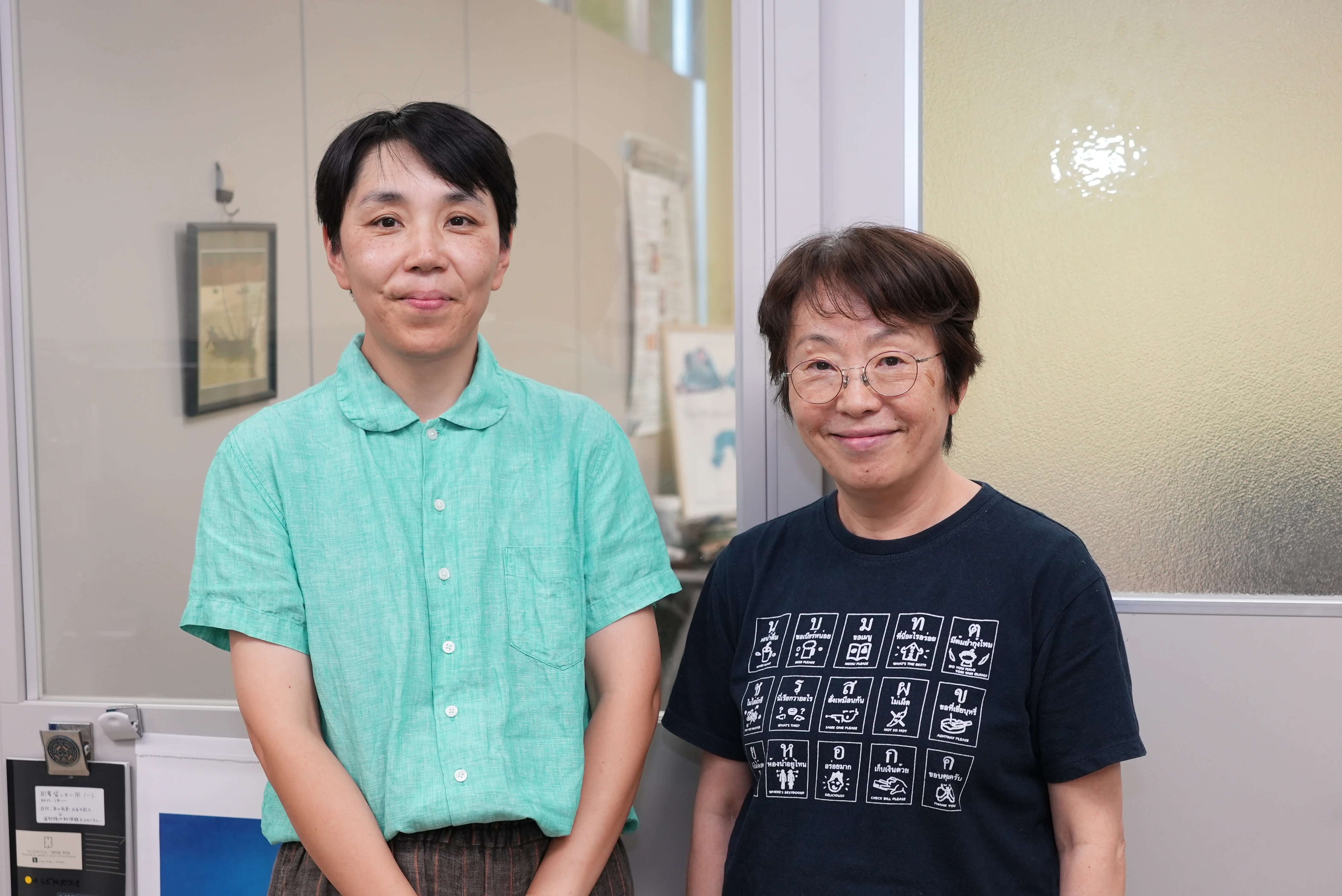
Miki Takahasi and Reiko Mazuka, Language Development Subgroup Project leader
What is your dream or goal as a researcher?
I want to make discoveries based on ideas that no one else has thought of before.
What advice would you give to young researchers or students who are interested in your research field?
I believe that good research begins with careful observation. When you take the time to observe something closely with your own eyes, you can uncover interesting questions that you might otherwise overlook.


