The quest for “atomic number zero”
Exploring the frontier of neutron-rich matter research through Japanese–Korean collaboration

Group Director
Nuclear Dynamics Research Group
RIKEN Nishina Center for Accelerator-Based Science (RNC)
Exotic nuclei composed entirely of neutrons—sometimes referred to as "atomic number zero" nuclei—as well as extremely neutron-rich nuclei such as super-heavy hydrogen isotopes containing only a single proton, have become a major focus of nuclear physics research worldwide. Tomohiro Uesaka, Group Director of the Nuclear Dynamics Research Group at the RIKEN Nishina Center for Accelerator-Based Science (RNC (opens in a new tab)), is leading efforts in this field under a new collaboration with the Institute for Basic Science (IBS) in South Korea. And in May 2026, an international accelerator experiment that also included researchers from Tohoku University and the Technical University of Darmstadt was launched to search for a variety of unconventional nuclear systems that conventional nuclear physics had long thought to be impossible.
The astonishing density of neutron stars
The human body consists of approximately 40 trillion cells, and each cell contains roughly 100 trillion atoms. Although this number is almost unimaginable, every atom has a nucleus at its center, which accounts for nearly all of its mass. In other words, nearly all of our body weight comes from atomic nuclei.
Atomic nuclei themselves are composed of two types of nucleons: protons and neutrons (Fig. 1). The number of protons defines the atomic number and determines the chemical identity of an element. Neutrons, meanwhile, play the essential role of binding positively charged protons together despite their mutual repulsion. Yet, neutrons rarely attract attention in everyday life because a free neutron is unstable: after about 15 minutes, it undergoes beta decay and transforms into a proton.

Figure 1: Atomic nucleus and neutron The atomic nucleus (left) is an extremely small object with a diameter of approximately 10-13cm (about one trillionth of a centimeter). It consists of protons (red) and neutrons (blue). The number of protons defines the atomic number and thus the chemical properties of the atom. The nucleus accounts for approximately 99.97% of an atom's mass, and its mass is determined by the total number of protons and neutrons (nucleons). A neutron is approximately 0.1% more massive than a proton (right). A free neutron is unstable and decays into a proton with a mean lifetime of about 15 minutes, so in nature neutrons can exist stably only when bound within an atomic nucleus.
"Despite their inconspicuous nature, neutrons have been key players throughout the 13.8-billion-year history of the Universe," explains Uesaka. "They are indispensable to the synthesis of the chemical elements."
One role they played was in the production of helium shortly after the Big Bang. Another is the formation of elements heavier than iron. The latter process is closely linked to neutron stars (Fig. 2), which are composed almost entirely of neutrons. A neutron star is an extraordinarily dense object: one the size of a single sugar cube would weigh hundreds of millions of tons (Fig. 3). Yet despite this enormous density, neutron stars do not collapse into black holes, and why this is so has been a longstanding mystery in astrophysics.
The quest for pure neutron matter
"Our goal is to create, for the first time on Earth, matter composed almost entirely of neutrons, similar to the material found inside neutron stars," says Uesaka.
One of the most significant scientific outcomes expected from the search for multineutron nuclei is a deeper understanding of the nuclear force, the fundamental interaction responsible for binding atomic nuclei together. Of particular interest is the three-neutron force, an interaction that emerges when three neutrons interact simultaneously. Clarifying this force could help explain why neutron stars remain stable instead of collapsing under their own gravity.

Figure 2: Artist's impression of the neutron star SRGA J1444. Adapted from a May 29, 2025 press relese regarding the CubeSat X-ray Satellite NinjaSat. (「キューブサットX線衛星NinjaSatによる宇宙観測の革新」) © RIKEN/Souichi Takahashi
Evidence for multineutron nuclei has been reported twice—in 2016 and in 2022—through experiments involving RIKEN. In these studies, heavy-ion beams accelerated to more than half the speed of light were directed at liquid helium or hydrogen targets in an attempt to produce multineutron systems. Rather than detecting the multineutron nucleus directly, researchers inferred the existence of a four-neutron system, known as the tetraneutron, by reconstructing the missing mass from the reaction products.
Detecting neutrons is inherently challenging because conventional radiation detectors rely on electromagnetic interactions, which do not help detect neutrons which carry no electric charge. A key instrument in previous experiments was NEBULA, a neutron detector attached to RIKEN's SAMURAI spectrometer. With this setup, artificially produced neutron-rich nuclei collide with hydrogen nuclei, and the energies and positions of the emitted neutrons are reconstructed from the trajectories and scintillation signals of recoil protons. However, because neutron-proton interactions are quite rare, the overall detection efficiency remains limited.
The next generation of experiments on extremely neutron-rich nuclei will require the simultaneous detection of multiple neutrons. A research team led by Associate Professor Kenjiro Miki of Tohoku University aims to produce both tetraneutrons and hexaneutrons—six-neutron systems by colliding the neutron-rich isotope helium-8 with a liquid hydrogen target (Fig. 4). Using NEBULA alone, however, the detection efficiency for tetraneutrons is only about 0.1%. The most effective way to improve this is to increase the detector depth along the flight path of neutrons. With the cooperation of a French research group—the Laboratoire de Physique Corpusculaire de Caen—the depth of the detector was doubled from 48 cm, but even then the detection efficiency increased only to slightly above 1%.
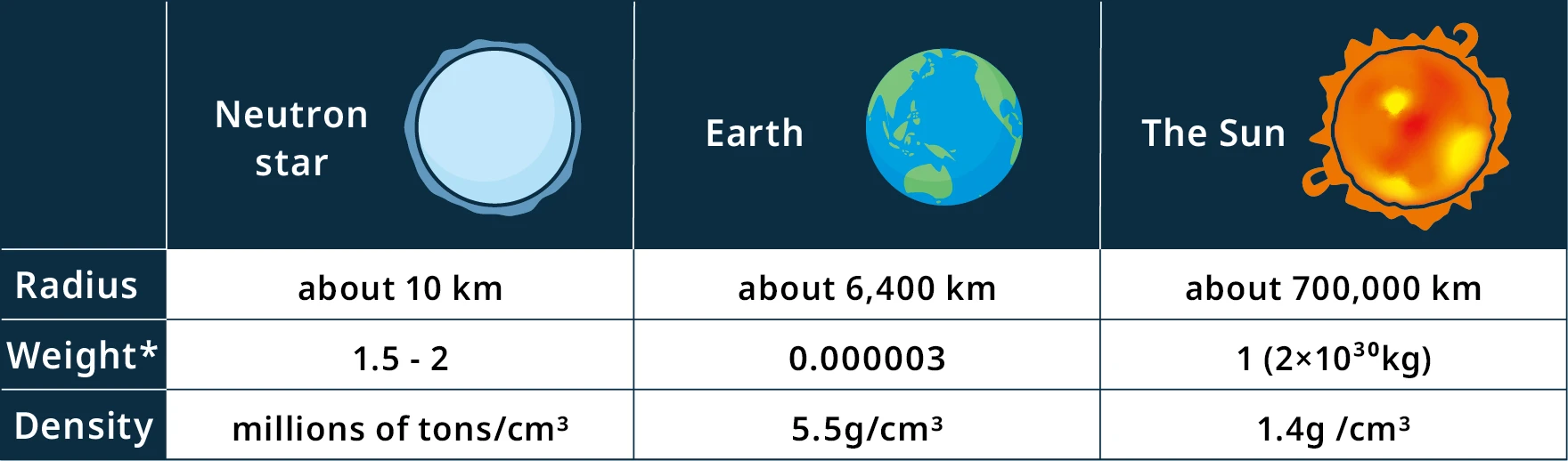
Figure 3: Comparison of a neutron star, Earth, and the Sun. Compared with the Sun, a neutron star has a radius that is only about 1/70,000 as large, yet its average density is approximately 100 trillion (1014) times greater. This extraordinary density makes neutron stars among the densest known objects in the Universe. Sizes are relative to the Sun (Sun = 1).
Japanese–Korean joint experiments begin
A major step forward for Uesaka came in 2023. Thanks to an invitation by Dr Deuk Soon Ahn, a Korean researcher who previously worked at RIKEN, he visited RAON, the heavy-ion accelerator operated by IBS.
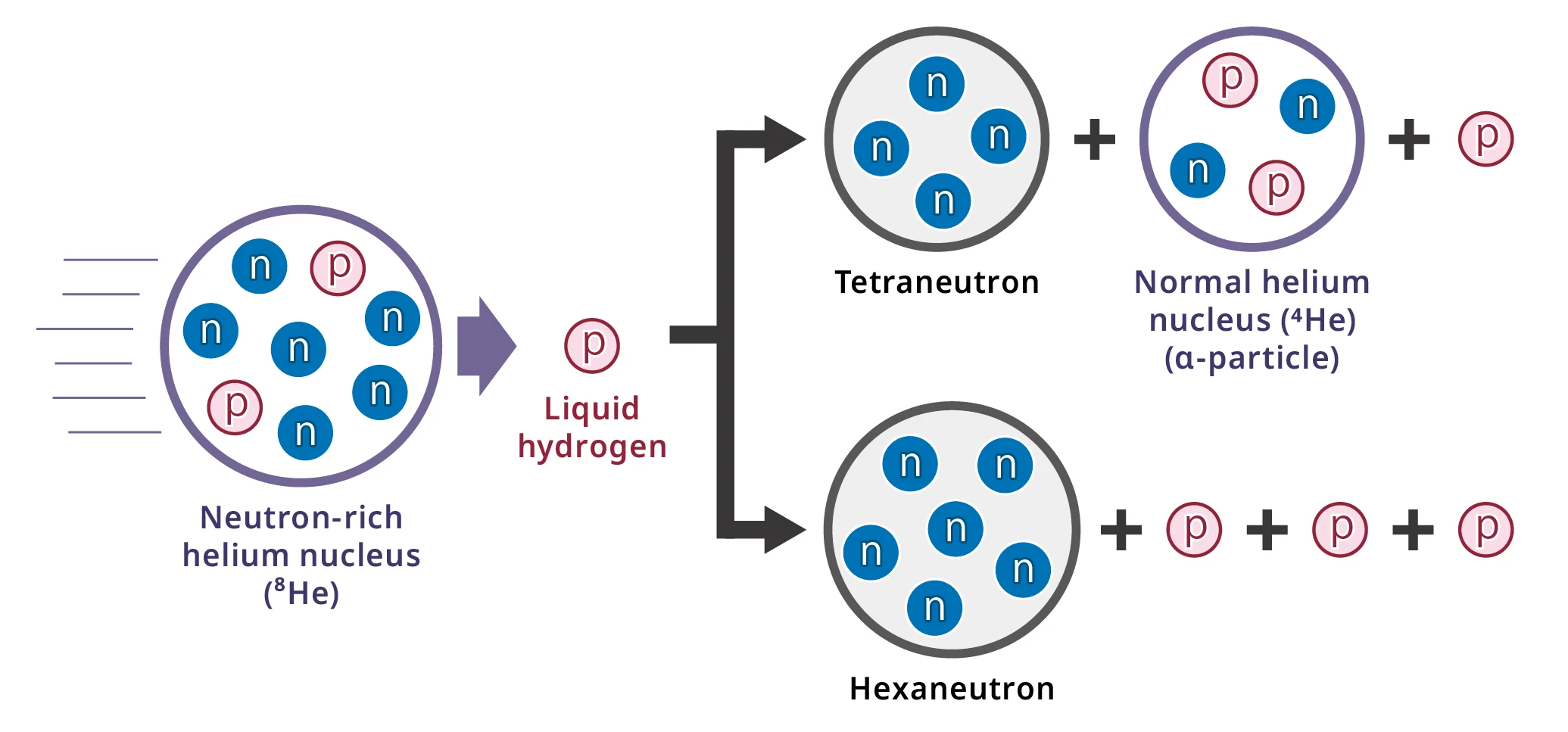
Figure 4. Schematic of the accelerator experiment for the search for multineutron nuclei At the RIKEN Radioactive Isotope Beam Factory (RIBF), an 18O beam is accelerated to approximately 60% of the speed of light using the Superconducting Ring Cyclotron (SRC) and other accelerator systems. The beam is then directed onto a beryllium target, where 8He nuclei are produced by projectile fragmentation. The Superconducting Radioactive Isotope Beam Separator (BigRIPS) is used to isolate the 8He beam, which retains nearly its original velocity. Finally, the purified 8He beam is directed to a liquid hydrogen target to search for the production of tetraneutron (4n) and hexaneutron (6n) nuclei.
As part of its strategy to strengthen world-class basic science while fostering innovation, in 2008 the Korean government launched what is known as the International Science and Business Belt initiative. In 2011, IBS was founded, inspired by institutions such as RIKEN and the Max Planck Society, and construction of the RAON accelerator began in stages from 2017. As of 2023, however, the high-energy section of the accelerator was still under construction. Meanwhile, the neutron detector LAMPS-NDA, which had already been completed, was not expected to be used for some time.
LAMPS-NDA has a detector depth of 80 cm. "The moment I saw it, I thought, this could work," recalls Uesaka. He immediately began discussing the idea with Drs. Byungsik Hong and Young Jin Kim, who lead the LAMPS project at RAON. Through subsequent symposia and workshops, researchers from the two countries deepened their collaboration. In 2025, LAMPS-NDA was relocated from South Korea to RIKEN, where it was integrated with the existing detector system. Joint accelerator experiments officially began in May 2026.
The addition of LAMPS-NDA substantially improved the detection efficiency. For the simultaneous detection of four neutrons, the efficiency nearly doubled to 3.5%. For six-neutron events, it increased by a factor of 2.5 to 0.44%. "The search for the hexaneutron is a world-first challenge," says Uesaka. "With detection efficiencies at this level, we have good reasons to expect meaningful results. Better detection efficiency also greatly increases our motivation for the experiment."
Strengthening scientific collaboration across Asia
The relocation of LAMPS-NDA to RIKEN demonstrated the strength of the Japanese–Korean partnership in multineutron research. Moreover, the collaboration has expanded beyond scientific exchanges to include substantial financial support from South Korea.
In 2024, the Korean government launched the Top-Tier Premier International Research Consortium, a funding program that promotes long-term partnerships between leading international research institutions and Korean organizations. The program provides research support for up to ten years. Among the four projects selected in its inaugural year was the joint RIKEN–IBS initiative.
Looking ahead, Uesaka emphasizes that international collaboration will be indispensable for advancing frontier science.
"International collaboration is essential for future cutting-edge research. We must strengthen cooperation among our colleagues across Asia. This project became possible only through the combined efforts of many people. I would especially like to thank Associate Professor Kenjiro Miki of Tohoku University, who leads the multineutron experiments; Dr. Meytal Duer of the Technical University of Darmstadt; our many collaborators; Dr. Taeksu Shin, Director of the IRIS Division at IBS and principal investigator of the Top-Tier project; and the IBS researchers whose efforts made the transfer of LAMPS-NDA to RIKEN possible."

LAMPS-NDA with researchers: Yosuke Kondo, Research & Development Scientist, Nuclear Dynamics Research Group (third from the right, first row), who played a key role in introducing LAMPS-NDA to RIKEN, together with colleagues. Uesaka (third from the right, back row) expressed his appreciation: "I would like to thank Hideaki Otsu, Team Leader, SAMURAI Team, Research Instruments Group and everyone who has contributed to our international collaborations at the RIKEN Nishina Center for Accelerator-Based Science, especially Center Director Hiroyoshi Sakurai."
This article was adapted from the original Japanese article (「原子番号ゼロ」を探せ――韓国と連携で拓く中性子過剰の世界) (opens in a new tab) published on the RIKEN (opens in a new tab) website.


